#11Q1) Mechanics and Properties of Matter
Verification of the relationship between the mass of a body suspended from a helix spring and its period of oscillation
Required Apparatus
A helix spring, a set of 50 g weights, a stop watch, a locating pin, and a stand.
Scientific Theory
If the suspended mass is , the spring constant of the spring is and the period of oscillation is ,
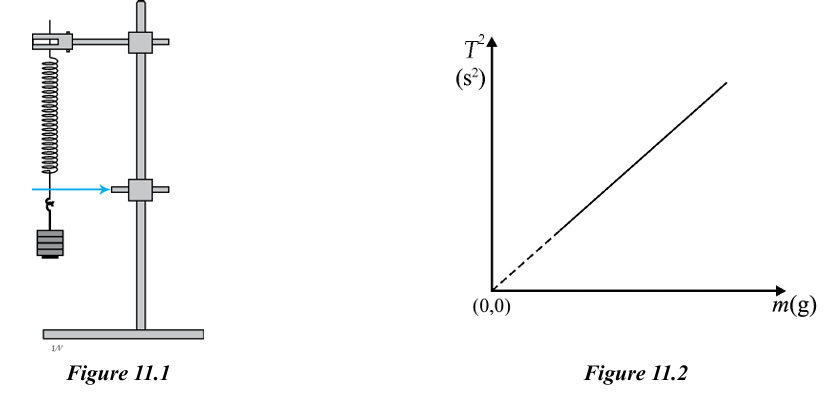
If the graph of against is a straight line through the origin, the relation is verified.
Experimental Method
- Suspend helix spring vertically from a fixed stand as shown in Figure 11.1 and from the lower end of the spring hang the initial weight of the set of weights (the dark portion).
- Attach an indicator horizontally to the end of the spring.
- When the spring is at rest and close to its path of oscillation as shown in Figure 11.1, connect the locating pin to the stand in line with the indicator.
- Pull down the suspended weight slightly and release it to make it oscillate in a vertical plane.
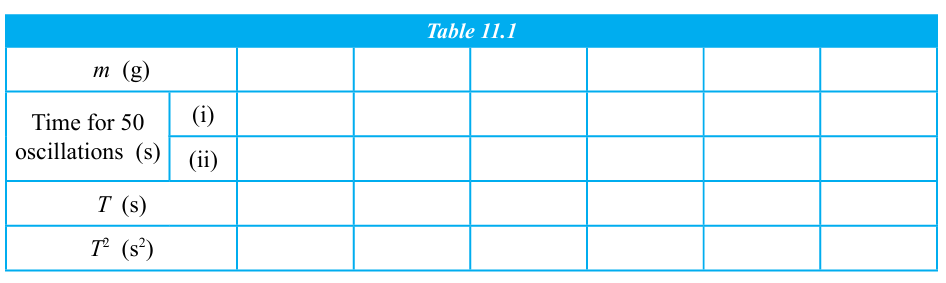
- Measure the time taken for 50 oscillations using the stopwatch. Obtain this measurement again.
- Repeat the experiment by increasing for about six values of .
Important Points
1
- Verify the relationship between mass and periodic time of the helix spring making use of the shape of the graph of against .
2
- Select the number of oscillations so that the percentage error of the measurement obtained according to the least count of the stopwatch and the rigidity of the helix spring is 1%.
3
- The formula is valid only when the displacement is small.