#10Q1) Mechanics and Properties of Matter
Determination of the acceleration due to gravity using the simple pendulum
Required Apparatus
A simple pendulum, a metre ruler, a stop watch, a locating pin, and a cork cut vertically in the middle.
Scientific Theory
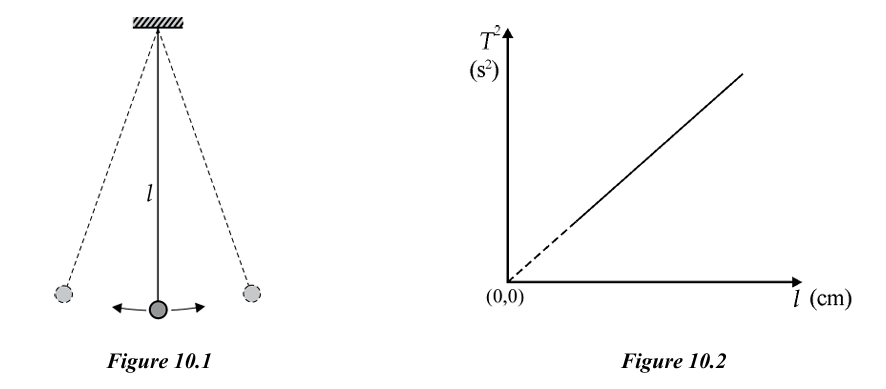
If is the oscillating length and the period of oscillation, of the simple pendulum,
Gradient of the graph against
Experimental Method
- Pass the pendulum string through the cork and suspend the pendulum from a stand.
- Measure the oscillating length of the pendulum from the point of suspension down to the centre of the pendulum bob.
- Note down the value of and fix the locating pin vertically below and close to the lowest point of the path of pendulum bob.
- Pull the bob aside till it is inclined by a small angle to the vertical ( or ). Release the pendulum to make it oscillate in a vertical plane and using the stop watch measure the time for 25 oscillations.
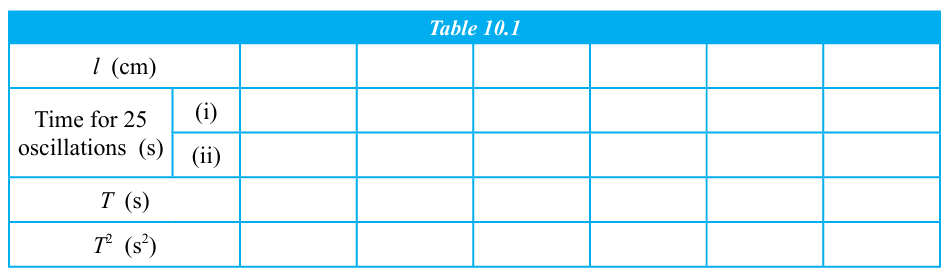
- Record the time and repeat the experiment by increasing the value of by 10 cm after starting from about cm. Obtain about six recordings.
Important Points
1
- Considering that the value of 'g' in Sri Lanka is , find the percentage error of the value you obtained with your experiment.
2
- Select the number of oscillations so that according to the least count of the stopwatch the percentage error of the measurement is 1%.
3
- The formula is valid only when the angle of oscillation is small.
4
- When oscillating the bob at a small angle, take care to make oscillations in a vertical plane. It would be an approximate elliptical motion.
5
- In order to activate the stop watch when the pendulum bob passes the locating pin, start counting in the descending order. eg.: 3, 2, 1, 0, 1, 2, ...., 25. Start counting from 3 when the bob passes the locating pin and activate the stop watch when counting 0. When the person who starts the stop watch gets used to this rhythm the personal error becomes minimal.