#5Q1) Mechanics and Properties of Matter
Verification of the law of parallelogram of forces and using it to determine the mass of a body
Required Apparatus
Parallelogram of forces apparatus, an object (a small stone or a glass stopper) of unknown mass, three known loads, a set square or a short plane mirror strip, a half metre ruler, pins, an A4 white paper, and a three beam balance.
Scientific Theory
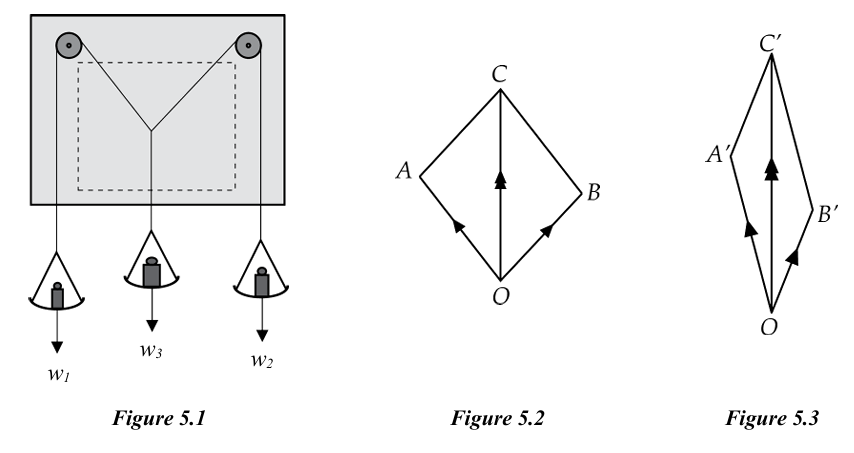
- Verification of the law of parallelogram of forces: Once the parallelogram OABC is constructed using a suitable scale, if the value of the product of the length OC of diagonal and the scale value is equal to the value of the load and also if diagonal OC stays vertically then the law of parallelogram of forces is verified.
- Determination of the mass of a body (load ): Once the parallelogram OA'C'B' is constructed using a suitable scale, the value of the product of length OC' of the diagonal and the scale value will be equal to the value of the mass of .
Experimental Method
- Fix the paper on the board. Place loads , and on the balance pans.
- Pull down middle load a little and release and test whether it returns to the original position.
- By placing the set square normal to the strings or the plane mirror strip below the string till the string covers its own image and then mark on the paper by two dots the projection of each string.
- Remove the paper from the board and draw lines across the dots marked on the paper.
- Measure the masses of the pans and add to the relevant loads.
- Choosing a suitable scale draw OA and OB with lengths proportional to the values of and respectively. Complete the parallelogram OACB and measure the length of diagonal OC.
- Confirm the validity of the law of parallelogram of forces in accordance with the above theory.
- Remove load and place the given body (load w) on it.
- Repeat the experiment as before and using the same scale, construct the parallelogram OA'B'C' and measure the length of the diagonal OC'. Deduce the mass of the given body in accordance with the theory.
Important Points
1
- Law of parallelogram of forces: If two forces acting on a point can be represented in magnitude and direction by two adjacent sides of a parallelogram, then the resultant of the two forces will be represented in magnitude and direction by the diagonal of the parallelogram passing through that angular point.
2
- After placing the loads on the pans of the parallelogram law apparatus the load on the middle pan is pulled down and released to test for friction. If the pan does not return to its original position indicating the presence of friction, application of a lubricant would minimize it.
3
- If the strings have weight their weights too get added to the relevant loads reducing the accuracy of the results. Weightlessness of the strings would add to the accuracy of the results of the experiment.