#6Q1) Mechanics and Properties of Matter
Determination of the mass of a body using the principle of moments
Required Apparatus
A metre ruler, a knife edge, a 50 g weight, a glass stopper or a small stone (of about 50 g mass), a piece of string, and a block of wood ().
Scientific Theory
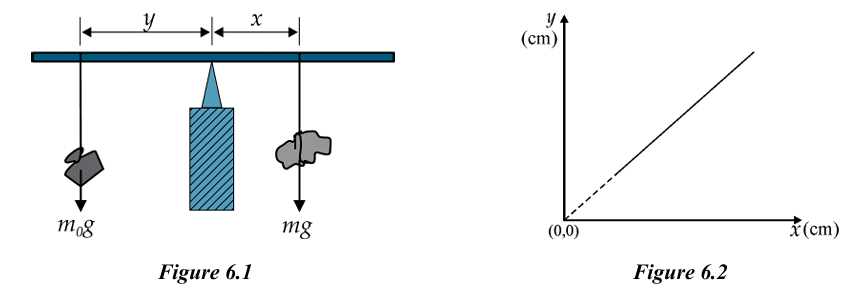
In the position of equilibrium, according to the principle of moments,
Gradient of the graph of y against
Experimental Method
- Place the knife edge on the stand and on it balance the metre ruler horizontally.
- As shown in Figure 6.1 suspend the known mass and the unknown mass on opposite sides of the knife edge and adjust length keeping length at a selected value until the ruler is balanced horizontally. Measure the values and .
- Repeat the experiment for five other selected values of so as to obtain a wide spread of readings.
- Enter the readings in the table. When taking readings take care to keep the balancing point of the ruler on the knife edge unchanged at the original position.
Important Points
1
- Measure the mass of the body using a balance and calculate the percentage error of experimental value.
2
- Explain with reasons of any deviations.