#4Q3) Waves and Optics
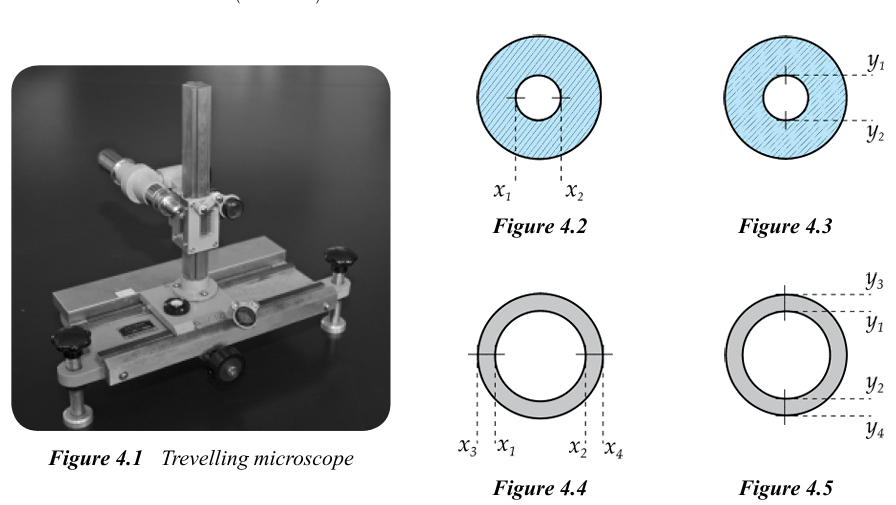
Usage of the travelling microscope
Required Apparatus
A travelling microscope, a capillary tube, a rubber tube, a stand, and a spirit level.
Scientific Theory
In an instrument with vernier scales, if divisions of the main scale coincides with divisions of the vernier scale, then,
- Mean internal diameter of capillary tube
- Mean internal diameter of rubber tube
- Mean external diameter of rubber tube
Experimental Method
- First determine the least count of the travelling microscope and note it down. Using a spirit level and adjusting the levelling legs, level the microscope.
- Fix the capillary tube co-axially with the microscope part of the instrument on a stand and focus the face of the capillary tube by the microscope.
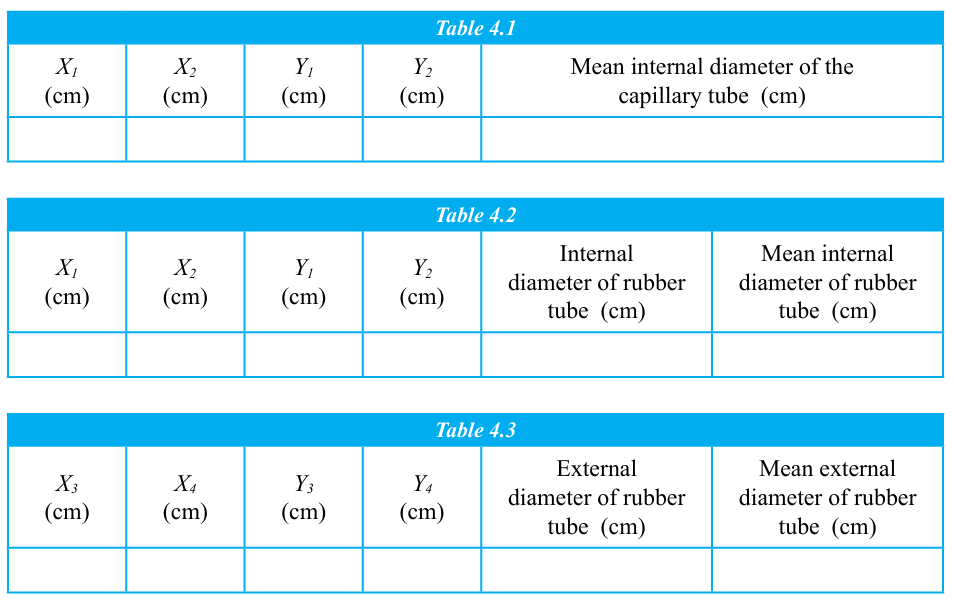
- Move the microscope horizontally until the cross wires of the microscope get adjusted as shown in Figure 4.2 and using the horizontal scale observe readings and . Next move the microscope vertically until its cross wires get adjusted as shown in Fig 4.3 and using the vertical scale observe readings and .
- Remove the capillary tube, insert the rubber tube in that position. Measure the internal horizontal diameter of the tube as shown in Figure 4.4 and obtain readings and . Next obtain the internal vertical diameter of the tube as shown in Figure 4.5 and obtain readings and .
- When measuring the external diameter of the rubber tube arrange it so that the cross wires are in contact with its external surface and obtain readings and as shown in Figure 4.4. and also readings and as shown in Figure 4.5.
Important Points
1
- Use a rubber tubing of about 5 cm in length and 5 mm diameter. Insert into the tube a cylindrical piece of wood of slightly smaller diameter than that of the rubber tubing to facilitate the fixing of the tube horizontally.
2
- When using the travelling microscope it is convenient to have a knowledge of the effective length (focusing length) of the microscope to perform the experiment. This value is mentioned in the trunk of the instrument and if not the microscope can be focused onto a square ruled paper and the distance between the paper and the eye piece end of the microscope can be measured.
3
- Focusing can be done with ease by placing in line the end of the rubber tube or the capillary tube at this distance.