#3Q1) Mechanics and Properties of Matter
Usage of the spherometer
Required Apparatus
A spherometer, plane (optically flat) piece of glass, a microscope slide, a clock glass, and a metre ruler or a vernier calliper.
Scientific Theory
If the screw pitch of the spherometer is and the number of divisions of the circular scale is , then
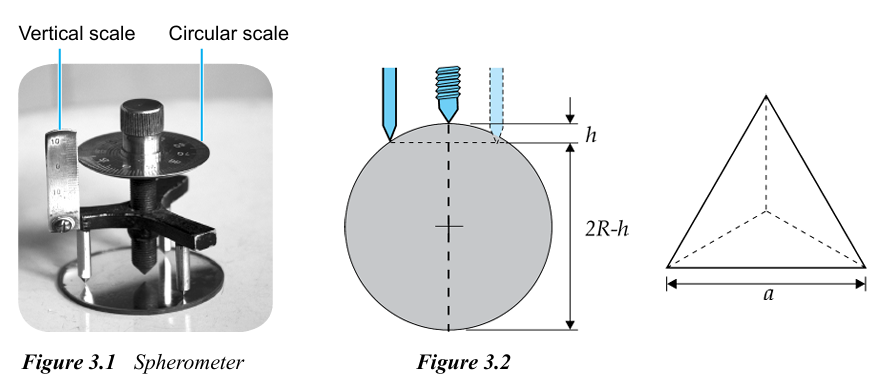
If is the height from the plane of the leg tips up to the point at which the screw tip touches the curved surface, the gap between the two legs of the spherometer and the radius of curvature of the spherical surface,
Experimental Method
- Find the least count of the spherometer. Place the three legs of the spherometer on the plane glass surface and screw the central leg until its tip touches the glass surface. This can be done by making the screw tip to come into contact with its own image formed by partial reflection on the glass surface. Obtain and note down the reading corresponding to the position of the screw tip using the readings of the vertical scale and the circular scale.
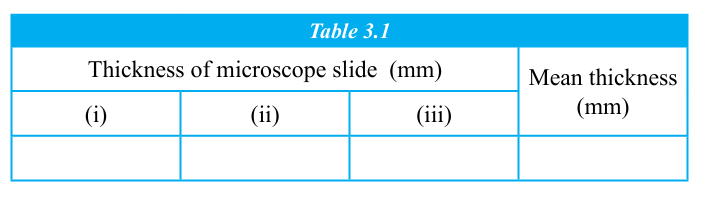
- Raise the screw a little and insert the microscope slide on the glass surface below the screw. Turn the screw until the screw tip touches the upper surface of the slide and observe the reading. Take similar readings on three spots of the slide. Record the difference between the reading obtained on the plane glass surface and these three readings.
- Place three legs of the spherometer on the spherical surface and adjust the screw for the screw tip to touch the spherical surface as shown in Figure 3.2. Observe the relevant reading and record the difference between this reading and the reading on the plane glass surface as .
- Place the spherometer on a paper and press on it. Measure using the tips of the internal jaws of a vernier calliper the distance between the marks made by the spherometer legs on the paper. Instead a metre ruler also could be used.
Important Points
1
- Depending on whether the surface is convex or concave, decide whether the first reading (the reading when the screw tip is on the plane of the leg tips) should be subtracted from or added to the second reading (when the screw tip is touching the curved surface).
2
- Care should be taken to read the reading on the circular scale according to the sense of rotation of the same scale. The reading on the scale can be taken directly as the correct reading if the circular scale is rotated anti-clockwise. If the circular scale is rotated clockwise, the reading on the circular scale has to be subtracted from the total number of divisions on the circular scale.