#2Q1) Mechanics and Properties of Matter
Usage of the micrometer screwgauge
Required Apparatus
A micrometer screwgauge (of about gauge 22), a thin wire, a steel ball (a ball bearing of about 5 mm), a microscope slide, and a photocopy paper.
Scientific Theory
If is the pitch of the screw and the number of divisions on the circular scale, then,
Experimental Method
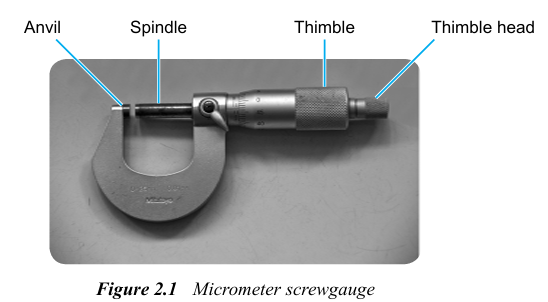
- Obtain the least count of the micrometer screwgauge. Rotate holding thimble head only until the spindle touches the anvil (when the spindle touches the anvil or when these two are in contact with any other object the thimble head would rotate freely making a "ticking" sound). Note down any zero error if shown.
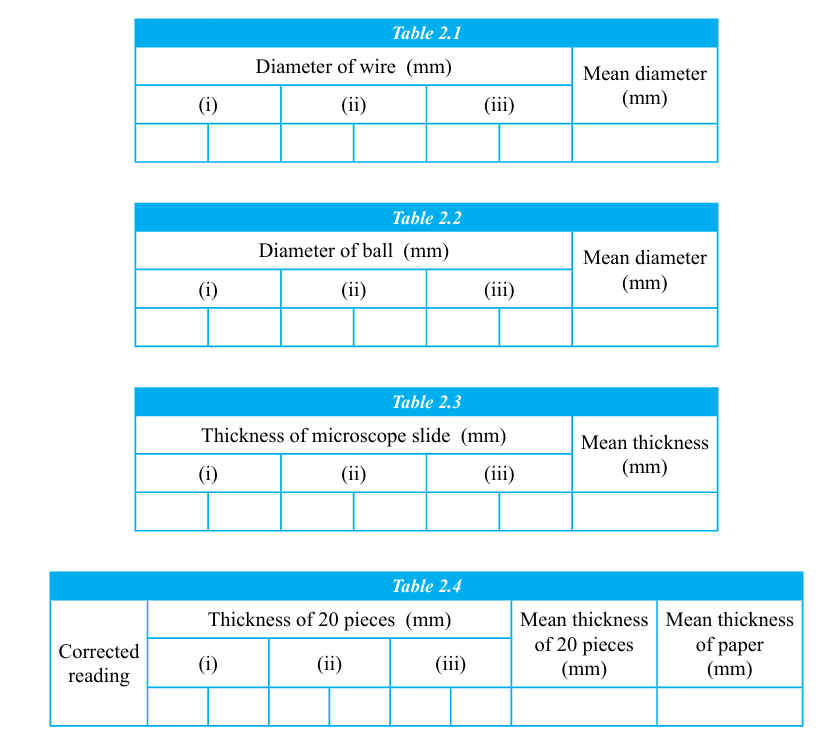
- To measure the diameter of the wire place it between the anvil and the spindle and rotate the thimble head until the wire is held properly between those two. Obtain the value of the diameter. Rotate the wire by and obtain reading again. Repeat these measurements for three places of the wire.
- Arrange the ball to fit properly between the anvil and the spindle and obtain readings for three diameters normal to each other.
- Arrange the microscope slide to fit between the anvil and the spindle and obtain readings for thickness of the slide in three different places.
- Cut the photocopy paper into 20 pieces, place the pieces one over the other into a bundle and obtain readings for thickness of the bundle at three different places.
Important Points
1
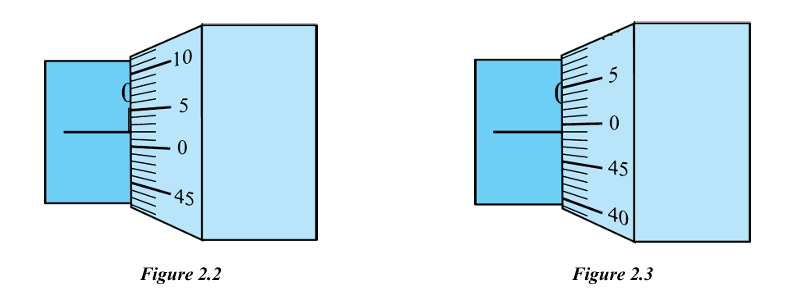
- It is important to read the zero error according to the position of the zero of the circular scale related to the line of the main scale of a micrometer screwgauge and also to decide whether for correction this value should be subtracted from or added to the relevant measurement.
2
3
- According to Figure 2.2 the zero error (the gap between the main scale line and the zero of the circular scale) is 0.02 mm. The rotation of the circular scale begins from 0.01 mm. Hence for correction this value should be subtracted from the relevant reading.
4
- According to Figure 2.3 the zero of the circular scale is situated above the main scale line. Accordingly the zero error is 0.01 mm. Hence for correction this value should be added to the relevant reading.
5
- When measuring the thickness of a photocopy paper the number of paper pieces should be selected to obtain a thickness reading so that the percentage error with respect to the least count of the instrument is less than or equal to 1%.