#1Q1) Mechanics and Properties of Matter
Usage of the vernier callipers
Required Apparatus
A vernier calliper, a block of wood (of about ), a PVC tubing ( 6 cm), a solid sphere (of diameter about 2 cm), and a hollow cylinder (Archemedes cylinder and bucket).
Scientific Theory
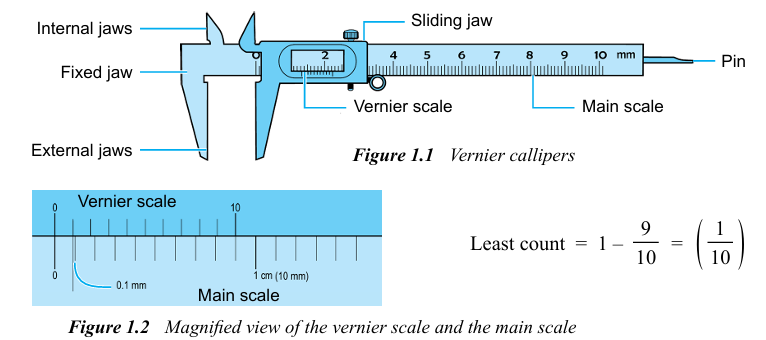
If the vernier calliper of the school laboratory has n divisions of its main scale divided into N divisions of the vernier scale,
- If the length is , breadth is and height is of the wooden block, its volume .
- If the external diameter is , the internal diameter is and length is of the tube, volume of the material of the tube .
- If the diameter of the sphere is , its volume .
- If the depth of the hollow cylinder is and its internal diameter , the volume of the cavity of the tube .
Experimental Method
- Find and note down the least count of the given vernier calliper.
- Measurement of length, breadth and height of the wooden block:
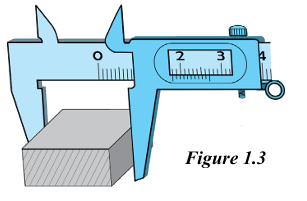
When taking measurements of the block hold it between the jaws of the caliper and calculate readings. Take measurements at three places for length, breadth and height and note down readings.
3. Finding the volume of the material of the PVC tubing:
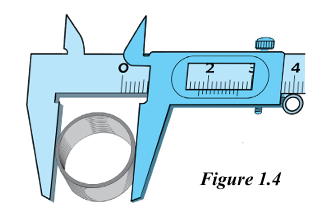
When measuring the external diameter of the PVC tubing adjust the vernier caliper as shown in Figure 1.4 and calculate readings. Take measurements of two diameters normal to each other.
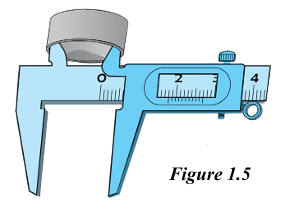
When measuring the internal diameter of the tubing adjust the vernier caliper as shown in Figure 1.5 and obtain readings. Take measurements of two diameters normal to each other.
Measure the length of the tubing in three positions. Take care to select these three positions keeping equal gaps between them.
4. Finding the volume of the material of a solid sphere:
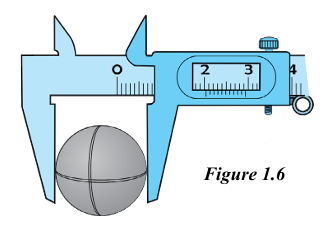
When measuring the diameter of the sphere adjust the vernier caliper as shown in Figure 1.6 and calculate the readings. Take measurements of two diameters normal to each other.
5. Finding the internal volume of a hollow cylinder: Calculate the internal diameter of the hollow cylinder as shown earlier in Figure 1.5.
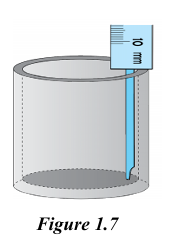
When measuring the depth of the cavity, adjust the vernier calliper as shown in Figure 1.7 and take readings in three places.
Important Points
1
- It is important to read the zero error of a vernier calliper according to the position of its zero mark and also to decide whether the correction should be subtracted from or added to the relevant measurement.
2
3
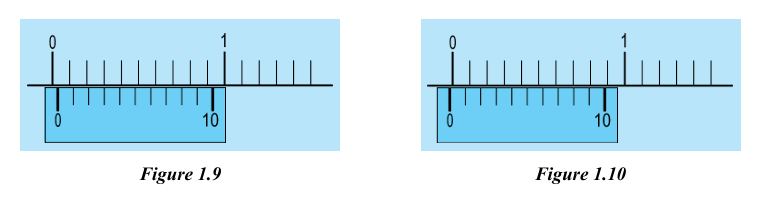
- According to Figure 1.9 the zero error (the gap between the zero of the vernier scale and that of the main scale) can be read directly from the scale. This value is 0.3 mm. Hence for correction, this value (0.3 mm) should be subtracted from the relevant reading.
4
- According to Figure 1.10, for zero error, the gap of the vernier divisions up to the reading at coincidence should be found and from it the gap of the main scale divisions should be subtracted to find the zero error. zero error . For correction this value (0.2 mm) should be added to the relevant reading.
5
- A more convenient method exists to determine the zero error. The value corresponding to the reading at coincidence should be first subtracted from the sum of all divisions in the vernier scale and this value has to be multiplied by the least count of the vernier scale. zero error .