#37Q4) Electricity and Electronics
Experimental investigation of the truth tables of simple fundamental logic gates and hence identification of the given gates
Required Apparatus
- A +5 V direct current supply, * IC types 7432, 7408, 7404, 7400, 7402, 7486, * Light emitting diodes (LED), * resistors, * resistors, * A digital multimeter, * A circuit board (bread board)
Scientific Theory
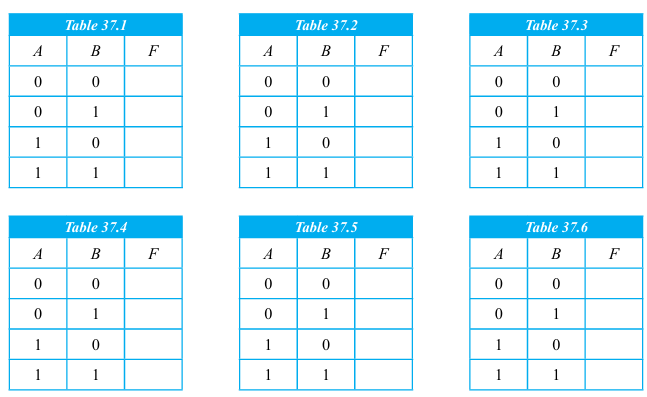
Truth tables of the relevant logic gates are given below. Note that '1' represents high voltage (+5 V) and '0' represents low voltage (0 V).
Experimental Method
- Fix a 7432 integrated circuit to the circuit board.
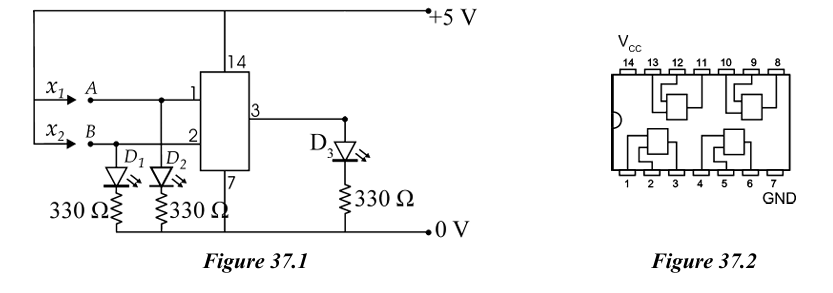
- Setup the given basic electronic circuit by connecting resistors to pins 1 and 2 of the circuit to act as inputs and a resistor and a LED to pin 3 of the circuit as shown in Figure 37.1. <image>
- By connecting the input terminals 1 and 2 to +5 V (1) and 0 V (0) alternately, observe whether the LED illuminates (1) or not (0) in accordance with the truth table of the OR gate.
- Verify the truth table of the first gate (out of the four) of the integrated circuit. Measure the voltage across the LED using a multimeter. Disconnect the +5 V supply and remove the integrated circuit from the circuit board.
- Connect another integrated circuit and repeat in the same manner followed by all other integrated circuits. Enter the result separately in the truth tables for the six ICs.
Important Points
1
- Using the truth table obtained, according to the integrated circuit number, conclude the logic gate in each circuit.
2
- Every integrated circuit here includes four equal gates. Only the first gate has been used above. (It is more suitable to keep the input terminals of remaining gates earthed.)
3
- Since TTL IC is used here +5 V supply is compulsory. If CMOS IC is used any voltage supply from +3 V to +15 V can be used. Then the values of the control resistors have to be altered. Calculate considering the specifications of LED's as 2.0 V, 10 mA.
4
- Instead of the above IC's the CMOS IC's 4001, 4011, 4071, 4081, 4069, and 4077 can be used in the respective order.