#34Q4) Electricity and Electronics
Determination of the internal resistance of a cell using the potentiometer
Required Apparatus
- Potentiometer, - Two 2 V accumulators, - Two 1.5 V dry cells, - Resistor box, - Dry cell holder, - Two-way key (), - One-way key (), - Jockey, - Sensitive galvanometer (), - Metre scale, - Connecting wires
Scientific Theory
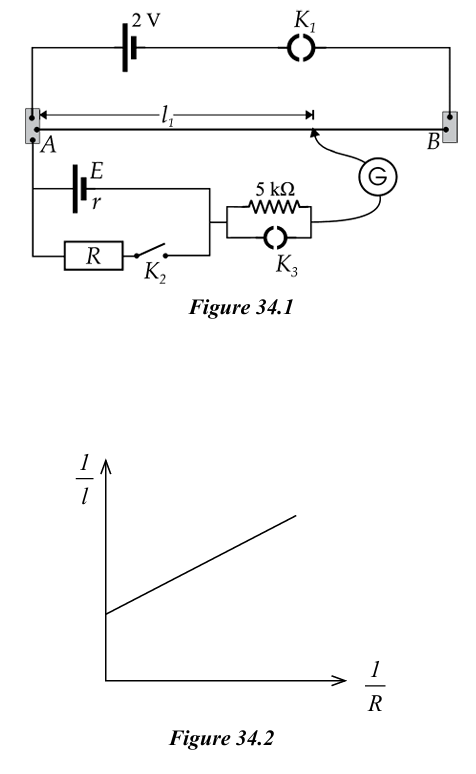
Let,
- = electromotive force (e.m.f.) of the cell
- = internal resistance of the cell
- = external resistance connected to the cell
- = balancing length when the key is open
- = balancing length when the key is closed
When the key is open:
When the key is closed:
Also,
Therefore,
Rearranging,
Or,
where
If is plotted against , a straight line is obtained.
From the graph,
- Gradient (or proportional to )
- Intercept
Hence,
Experimental Method
- Set up the circuit as shown in the figure.
- Check the circuit as done in the potentiometer experiment.
- Close key and key open.
- Find the balancing length and record it.
- Close key to connect the resistor box across the cell.
- Measure the new balancing length .
- Repeat the experiment for several values of .
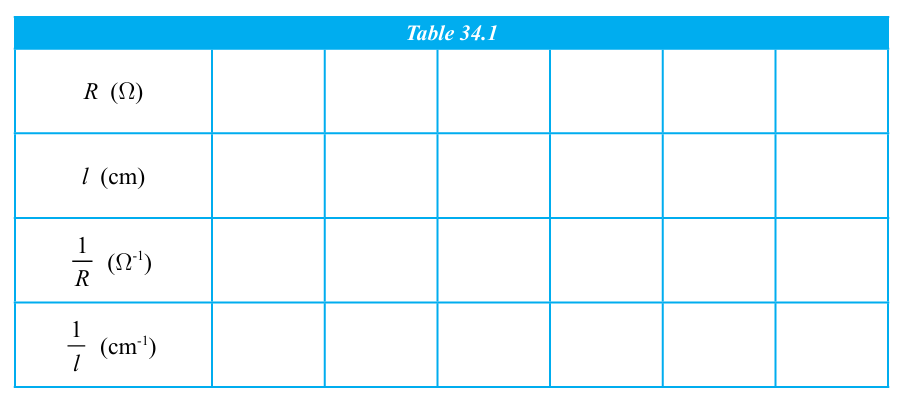
- Record all values in Table 34.1.
| (Ω) | |||||
|---|---|---|---|---|---|
| (cm) | |||||
| (Ω) | |||||
| (cm) |
- Plot the graph of:
- Determine the gradient of the graph.
- Determine the intercept of the graph.
- Calculate the internal resistance using:
Calculate and state the value of the internal resistance of the cell.
Important Points
1
- Close key only when taking readings.
2
- If the minimum value of is too small (below about 20 Ω), the cell may discharge rapidly and give inaccurate results.