#33Q4) Electricity and Electronics
Comparison of electromotive forces of two cells using the potentiometer
Required Apparatus
- Potentiometer, - 2 V lead-acid accumulator, (or two 1.2 V Ni-Cd cells connected in series), - Leclanché cell, - Daniell cell, - Centre-zero galvanometer, - Two-way switch, - Two plug keys, - 5 kΩ safety resistor, - Sliding contact (jockey), - Connecting wires
Scientific Theory
If is the balancing length when the two-way switch is connected to cell and is the balancing length when the same switch is connected to cell ,
Experimental Method
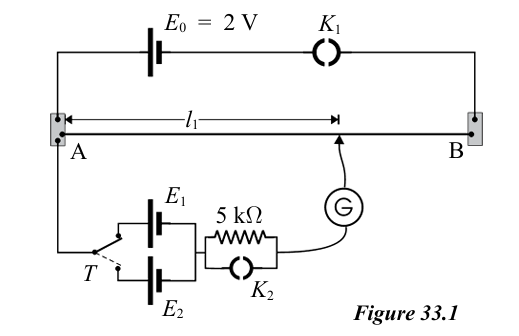
- Set up the circuit as shown in Figure 33.1.
- Close key while keeping key open.
- Connect the two-way switch to cell .
- Check the circuit by touching the sliding contact to ends A and B of the potentiometer wire.
- If the galvanometer deflections are in opposite directions, the circuit is correct.
- Find the balance point for cell and record the balancing length .
- Close key and obtain a more accurate value of .
- Connect the two-way switch to cell .
- Repeat the procedure and record the balancing length accurately.
Important Points
1
- If the galvanometer shows deflections in the same direction at both ends of the potentiometer wire, possible reasons are:
2
- Incorrect connection of cell terminals.
3
- Loose connections in the circuit.
4
- The potentiometer supply cell is partially discharged.
5
- If the galvanometer shows no deflection at both ends, check for broken or disconnected wires.
6
- A more accurate value of can be obtained by taking several sets of readings with different resistance values and plotting against .
7
- The gradient of the graph of against gives:
8
9
\frac{E_1}{E_2}
10
11
- Potentiometers with different wire lengths (2 m, 4 m, 8 m, etc.) are available. The wire length should be considered when measuring balancing lengths.