#9Q1) Mechanics and Properties of Matter
Determination of the density of a liquid using a weighted test tube
Required Apparatus
A boiling tube, a tall jar, a few mass units, a vernier calliper, a graph paper strip marked in milimetres, a sufficient amount of a solution of sodium chloride, lead shots / small iron balls (bicycle), and a small quantity of wax.
Scientific Theory
- : volume of the portion in the tube filled with wax
- : mass of the tube a with its contents
- : external area of the cross section of the cylindrical portion of the tube
- : mass of additional weights inserted into the tube
- : density of the liquid
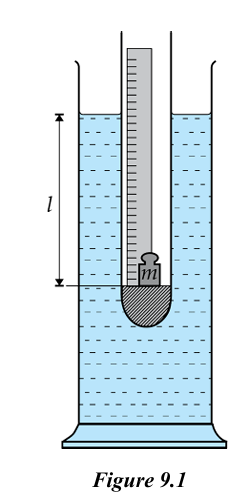
- : length of the cylindrical portion (above wax level) immersed in the liquid when the tube floats in a liquid
According to the principle of floatation:
If is the gradient of the graph of against ,
If is the external diameter of the tube,
Experimental Method
- Put the minimum amount of lead shots that would make the boiling tube float vertically in the liquid.
- Pour wax into the tube until the lead shots are completely covered (the spherical portion of the tube should be filled with wax).
- Paste the paper strip on the inner wall so that the zero of the scale begins from the lower end of the cylindrical portion (Figure 9.1).
- Fill the tall jar with the liquid (sodium chloride), make the tube float vertically in it and record the length of the tube immersed in liquid.
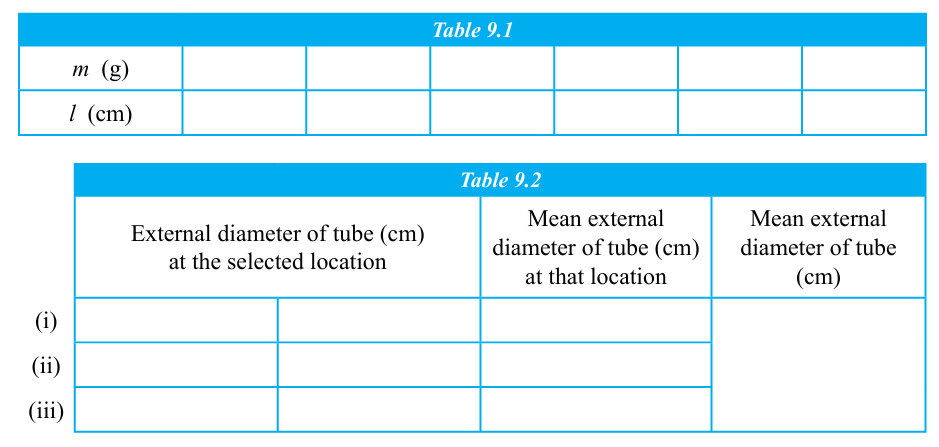
- Insert one mass unit () into the tube and record the corresponding value. Increase and obtain about six values.
- Measure the external diameter of the tube using a vernier calliper at three different places of the tube taking three readings normal to each other at each place.
Important Points
1
- Discuss the precautional measures to be taken to increase the accuracy of the results obtained in the experiment.
2
- Determine first the maximum mass that could be inserted into the tube to immerse it in the liquid while adding weights from a small value until its open end reaches the liquid level. Divide this value of the maximum mass into six equal values and obtain readings by adding each time a mass equal to this value into the tube. This would enable to obtain a good spread among the readings.
3
- Sufficient lead shots are put into the tube to float the tube vertically and wax is poured to cover it completely. Care should be taken to pour wax to fill completely the hemispherical portion of the tube as shown in Figure 9.1.
4
- When using a box of weights for the experiment it may become necessary to remove some added weights. This inconvenience can be avoided by arranging equal mass units.