#29Q2) Heat
Determination of relative humidity of air using a polished calorimeter
Required Apparatus
Two calorimeters with polished outer surfaces, a suffi cient amount of ice chips, a stirrer, two (0 - 50), °C thermometers, a sheet of glass and two stands.
Scientific Theory
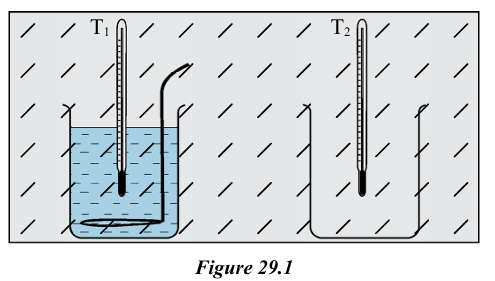
Experimental Method
- Wipe out well the outer surface of the calorimetres and fill about a half of one calorimeter with water.
- Fix the two thermometers and as shown in Figure 29.1. Also fix the sheet of glass in front of the calorimeters to prevent your exhaled air reaching the calorimeters.
- Insert ice chips into water in the calorimeter one after the other while stirring each one after the previous one has dissolved.
- Observe the beginning of the tarnishing of the calorimeter surface due to depositing of dew by comparing the surface with the outer surface of the other calorimeter.
- In the situation where dew begins to deposit, observe and note down the reading of the thermometer inserted into the calorimeter containing water.
- Now stop adding ice and continue stirring to allow the temperature of the water to rise when the shine of the calorimeter begins to reappear indicating the vanishing of dew, observe the reading of the same thermometer and note it down.
- Finally observe and record the room temperature from the thermometer .
- Calculate the mean of the two temperatures and consider it as the dew point.
- Using a table giving standard values of saturated vapour pressure, obtain its values at the dew point and at the room temperature ( and ).
- Calculate the relative humidity using the expression given in the theory.
Important Points
1
- Conclude the value obtained from the above calculation as the relative humidity.
2
- Discuss the necessity to use small ice chips for the experiment. Discuss the difficulties you would face in measuring temperatures and if large pieces of ice are used.
3
- In selecting the glass sheet to prevent exhale striking the calorimeter, take care to decide on its dimensions so that it would not obstruct stirring but would have the size sufficient for the purpose it is used for.