Determination of the specific latent heat of vaporization of water by the method of mixtures
Required Apparatus
A calorimeter, a stirrer, a thermometer, a steam generator, a steam trap, a four beam / chemical balance, an insulating sheet (rigifoam / asbestos), a bunsen burner, a tripod, a wire mesh, and a thermometer.
Scientific Theory
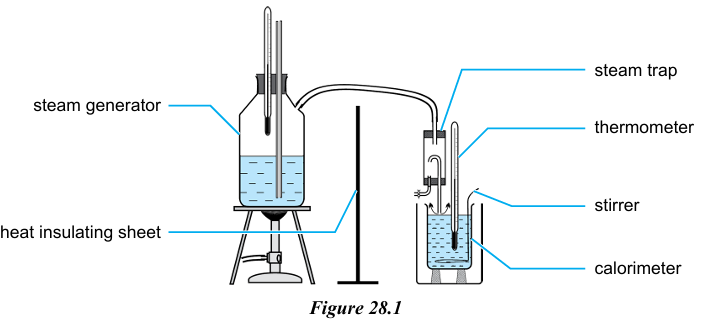
In the experiment described above, let:
- = mass of the empty calorimeter with the stirrer
- = mass of the calorimeter with water
- = initial temperature of the water
- = maximum temperature of the water after mixing with steam
- = mass of the calorimeter with the mixture
- = specific heat capacity of the calorimeter material
- = specific heat capacity of water
- = specific latent heat of vaporization of water
Assuming there is no heat loss to the surroundings,
Therefore,
Experimental Method
Measure the mass of the empty calorimeter together with the stirrer.
Fill the calorimeter to about two-thirds of its volume with water and measure the mass of the calorimeter with water.
Arrange the steam generator so that steam enters the calorimeter through the steam trap, and allow the steam to strike the surface of the water.
Stir the mixture continuously until the temperature rises by about above the initial temperature.
Remove the steam inlet and continue stirring until the maximum temperature is reached. Record this temperature as .
Finally, measure the mass of the calorimeter and its contents.
Important Points
- The calorimeter should be polished and insulated to reduce heat loss to the surroundings.
- A more accurate method is to perform the experiment under constant environmental conditions and compensate for any heat lost or gained.
- Before starting, allow the water in the calorimeter to remain until it reaches room temperature.
- Begin stirring continuously while introducing steam to ensure a uniform temperature throughout the water.
- The maximum temperature should be limited to about above room temperature so that heat gained from the surroundings before this point approximately balances heat lost to the surroundings after this point.
- The final temperature should remain below the dew point to avoid condensation on the calorimeter.
- The steam trap is essential to ensure that only dry steam enters the calorimeter. Water droplets carried with the steam would introduce additional mass and reduce accuracy.
- The steam inlet tube should not be immersed in the water, as this can cause water to enter the tube and affect the measurement.
- Sufficient steam should be introduced to produce a measurable temperature rise, but excessive heating should be avoided.
- The calorimeter should be weighed immediately after the experiment to minimize mass loss due to evaporation.