#30Q2) Heat
Determination of the thermal conductivity of a metal by Searle’s method
Required Apparatus
Searle's apparatus for determination of thermal conductivity, two thermometers, two thermometers, a steam generator, a constant pressure apparatus, vernier caliper, a stop clock, a 100 ml beaker, and a triple beam balance.
Scientific Theory
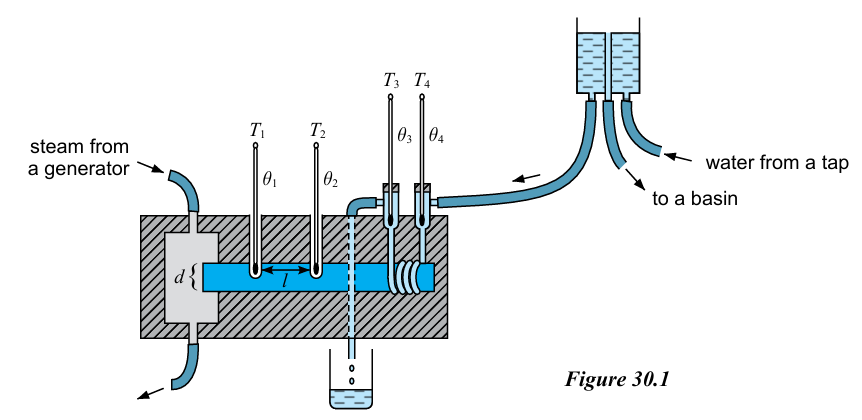
As shown in the above Figure 30.1, let:
- : mean diameter of the bar
- : distance between thermometer and
- : readings of the thermometers in the steady state
- : mass of water collected in the beaker
- : time during which water is collected
- : specific heat capacity of water
- : thermal conductivity of the material of the bar
Then
Experimental Method
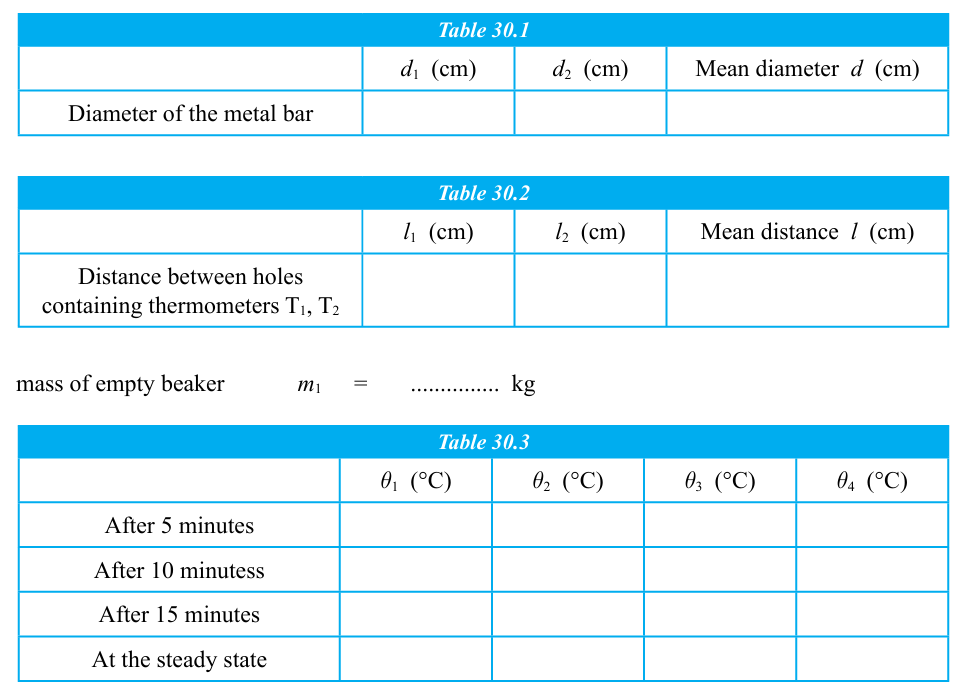
- First open the wooden box and using the vernier calliper measure two diameters of the bar in two directions normal to each other to get the mean diameter.
- Also using the calliper measure distances from inside and from outside between the thermometer and with the help of the outer jaws and the inner jaws of the calliper.
- Close the box now to provide heat insulation.
- Insert the thermometers and into the respective holes containing mercury to ensure good thermal contact.
- Use the upper inlet of the steam chamber to admit steam so that the chamber will be completely filled with steam throughout the experiment.
- Connect the water outlet of the constant pressure apparatus to the thermometer chamber so that the incoming stream of water would oppose and meet directly the heat conducted along the bar.
- Note down the readings of the four thermometers at five minute time intervals.
- When all these four readings become constant indicating steady state record the four readings . If the difference between the readings of and is not sufficient, adjust the height of the water pressure head to obtain a sufficient difference.
- Finally collect water from the outlet into an initially weighed beaker for a time which is measured by a stop clock. Collect about 500 ml of water and measure the mass of the beaker with the water .
- Taking the specific heat capacity of water as 4200 J kg⁻¹ K⁻¹ calculate as explained in the theory.
Important Points
1
- Note down the value obtained from the calculation as the thermal conductivity of the metal.
2
- Obtain the standard value of the thermal conductivity of the metal for (copper) from a data book and compare with your experimental value. Calculate the percentage error. Forward your suggestions and ideas to perform the experiment more accurately.
3
- Consider why the side to admit steam to the steam chamber and the side to admit the continuous water steam to the copper tube are being selected this way. (This selection is compulsory). In certain apparatus the lower opening is made larger and the upper opening smaller. In this case the steam can be supplied from the bottom and the chamber would be filled with steam.