#32Q4) Electricity and Electronics
Determination of temperature coefficient of resistance of a metal (Cu) using the Metre Bridge
Required Apparatus
- Insulated copper wire (40 SWG) coil of about 100 Ω resistance, - Centre-zero galvanometer, - Sliding contact (jockey), - Two plug keys, - Lead accumulator or 2 V d.c. power supply, - Two 1.2 V Ni-Cd cells connected in series, - Thermometer (0–100 °C), - Water heater, - Wire mesh, - Tripod stand, - Bunsen burner, - Metre bridge, - 5 kΩ resistor, - Resistance box (0–500 Ω), - Rheostat, - Connecting wires
Scientific Theory
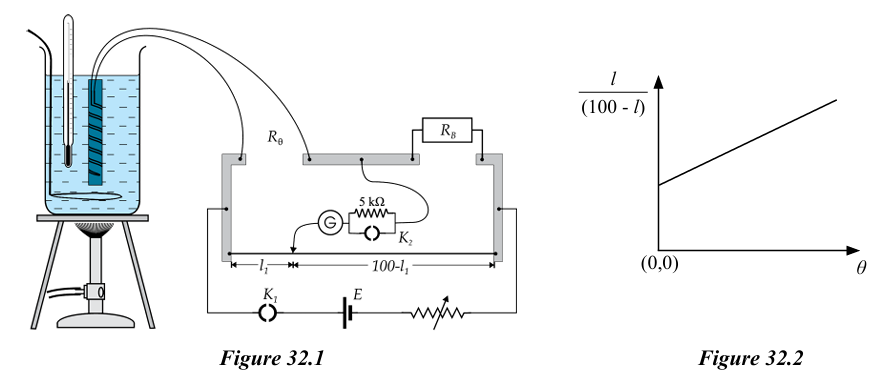
When the bridge is balanced,
where:
- = resistance from the resistance box
- = resistance of the copper coil at temperature
- = resistance of the coil at
- = temperature coefficient of resistance
The resistance at temperature is given by:
Therefore,
Rearranging,
If is plotted against :
- Gradient
- Intercept
Hence,
Experimental Method
- Connect the circuit as shown in Figure 32.1.
- Close switch and keep open.
- Measure and record the initial temperature .
- Stir the water well and obtain the rough balance point.
- Close switch and obtain the accurate balance point.
- Measure and record the balancing length .
- Heat the water while stirring continuously.
- For every increase of , measure the corresponding balancing length .
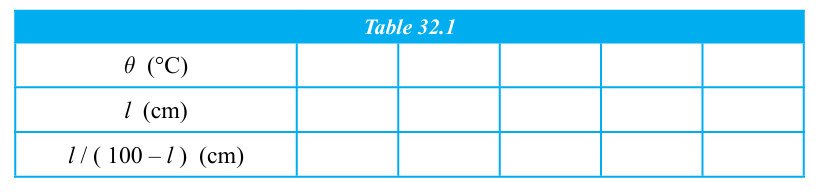
- Record about six sets of readings.
Important Points
1
- Plot against .
2
- Determine the gradient and intercept of the graph.
3
- Calculate the temperature coefficient of resistance using:
4
5
\alpha
6
=
7
\frac{\text{Gradient}}{\text{Intercept}}
8
9
- Compare the experimental value of with the standard value for copper and calculate the percentage error.
10
- Discuss possible sources of error and methods to reduce them.
11
<image>
12
- Use a cylindrical wooden rod about 10 cm long and 2.5 cm in diameter.
13
- Take approximately 5 m of insulated copper wire (40 SWG).
14
- Fold the wire into two equal strands.
15
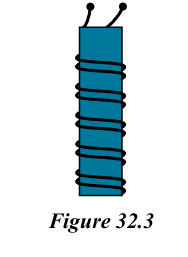
- Wind the double strand around the wooden rod as shown in Figure 32.3.
16