#24Q2) Heat
To verify the relationship between the pressure and the absolute temperature of a gas at constant level
Required Apparatus
A constant pressure gas apparatus with a pressure gauge, a thermometer, a beaker of water, a Bunsen burner, a tripod, a wire gauze, a stand, and a stirrer.
Scientific Theory
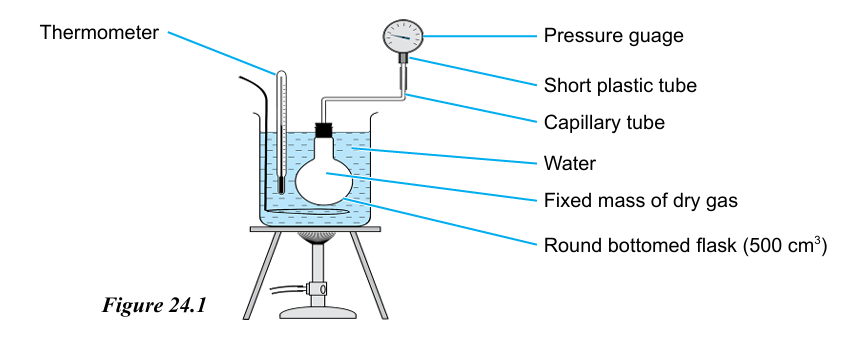
As shown in Figure 24.1 if is the pressure of the air enclosed in the bulb and the absolute temperature of the gas, then according to the law of pressures the relationship between and of a fixed mass of a gas at constant volume is,
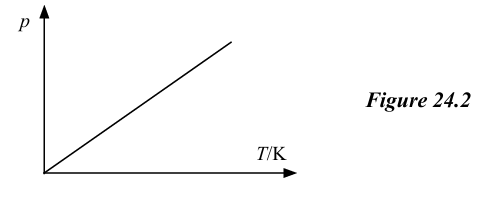
When is plotted against the graph would be as follows.
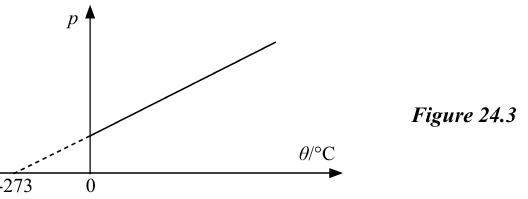
If the temperature is measured in the graph would be as follows:
Experimental Method
- As shown in Figure 24.1 place the bulb of the constant volume apparatus, the thermometer and the stirrer in the water in the beaker.
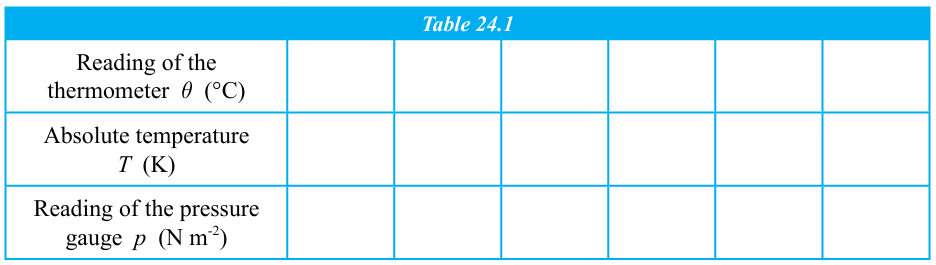
- Heat the water in the beaker while stirring and when the temperature has risen by about remove the burner and when the temperature becomes still note down the temperature reading and the pressure gauge reading.
- Continue to heat the water in the beaker and at every rise of of temperature take relevant readings six times.
- Plot pressure against absolute temperature .
Important Points
1
- As stated in the theory, according to the graph the relationship between the pressure and the temperature of a gas at constant volume is verified.
2
- The temperature of the water in the heater should be raised very slowly and the water should be continuously stirred.
3
- Since the temperature of the air in the tube connecting the bulb and the gauge and the temperature of the air in bulb do not exist at the same value, the resulting error can be minimised by using a bulb with a large volume and a capillary tube as the connecting tube.