Determination of the surface tension of water by capillary rise method
Required Apparatus
A capillary tube of about 15 cm in length, a travelling microscope, a beaker, an adjustable bench, a pin or a pointer bent at a right angle, pure water, diluted sodium hydroxide and diluted nitric acid, solutions in small amounts, a stand and thin rubber loops.
Scientific Theory
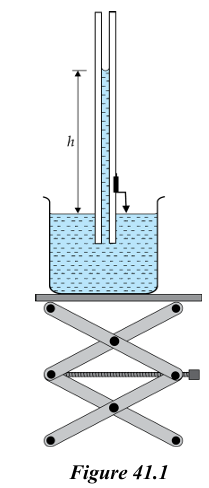
If is the capillary rise of a liquid of surface tension , and density in a capillary tube of radius ,
then
where is the relevant angle of contact.
The angle of contact between pure water and clean glass is considered to be zero.
Then,
Experimental Method
Wash the capillary tube first with the diluted sodium hydroxide solution, then with the diluted nitric acid solution, and finally with pure water and dry it. Place the beaker of water on the adjustable bench, attach the bent pin or pointer to the capillary tube by means of rubber loops, and fix the tube vertically to the stand so that the lower end of the tube just gets immersed in the water in the beaker.
Then, by lowering or raising the adjustable bench, obtain the position where the tip of the pin just touches the water surface after the capillary rise of the liquid in the tube is complete. Observe the water meniscus in the tube through the travelling microscope. Focus the image so that the base of the meniscus touches the horizontal crosswire of the microscope. Obtain the readings:
- on the vertical scale of the microscope.
- and on the horizontal scale and focus scale, respectively, with the pin (or pointer) just touching the horizontal crosswire.
- on the vertical scale of the microscope.
- and on the horizontal and focus scales, respectively, after adjusting the microscope to coincide with the capillary tube.
Capillary rise:
Mean diameter of the capillary tube:
Radius of the capillary tube:
Using
the surface tension of water is
Important Points
The capillary rise can be obtained at a few more places along the tube by changing the amount the
tube is immersed in the liquid and calculate the surface tension. By taking the mean of all these
values of surface tension any error due to non-uniformity of the capillary can be minimized.