Determination of the surface tension of a liquid by Jaeger’s method
Required Apparatus
Jaeger’s apparatus set, a beaker, the liquid of which surface tension is required, a quantity of, kerosene oil, a travelling microscope, a block of wood or an adjustable bench and two stands
Scientific Theory
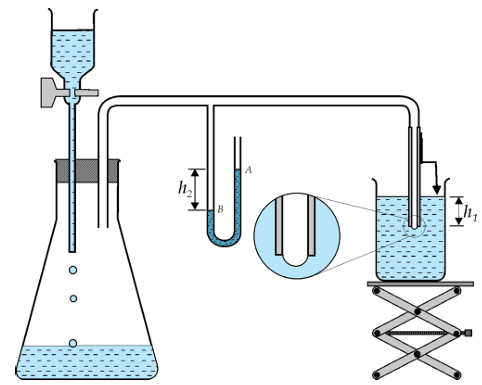
Let be the surface tension of the liquid, its density, the density of kerosene oil used in the manometer, the radius of the capillary tube in the apparatus, the maximum height difference between the liquid levels in the manometer, the depth of the lower end of the capillary tube from the liquid level in the beaker, and the atmospheric pressure.
Then,
Therefore,
Experimental Method
Method
Set up the Jaeger’s apparatus as shown in Figure 42.1. Introduce a sufficient amount of kerosene oil into the manometer. Fix the capillary tube vertically on a stand. Place the beaker containing the liquid on the adjustable bench or any other suitable stand and adjust it so that the lower end of the capillary tube is immersed in the liquid as shown in Figure 42.1.
Attach a bent pin or a pointer to the capillary tube so that its tip touches the liquid level in the beaker. Open the tap so that water flows into the larger flask. Adjust the setup until the increasing pressure in the flask forces air out of the capillary tube into the liquid in the beaker in the form of an air bubble.
To find the maximum height difference in the manometer, first observe the highest position of the liquid level in limb A of the manometer. Focus the travelling microscope on the lowest position of the meniscus and record the reading on the vertical scale of the microscope.
Next, observe the lowest position of the meniscus in limb B and, after focusing the microscope on the meniscus, record the reading on the vertical scale.
Enter these readings in Table 42.1.
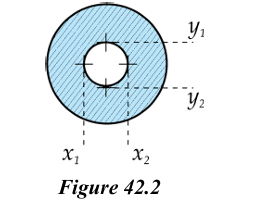
Remove the liquid beaker and observe the tip of the pin or pointer attached to the capillary tube through the microscope. Focus the tip on the horizontal cross wire of the microscope and record the reading on the vertical scale.
Similarly, focus the microscope on the lower end of the capillary tube and record the reading on the vertical scale.
Record these readings in Table 41.2.

Substituting the values of , , , and , and the radius
into the expression given in the theory, calculate the value of the surface tension .
Important Points
- The method can be used for transparent as well as translucent liquids, since the pressure is measured using a manometer rather than by visual observation of the liquid surface.
- The radius of the capillary tube must be known accurately.
- The maximum manometer height difference occurs just before the bubble detaches.
- By taking readings at different temperatures, the variation of surface tension with temperature can be studied.
- Surface tension decreases with increasing temperature.