Determination of the coefficient of viscosity of a liquid (water) by capillary flow method using Poiseuill’s formula
Required Apparatus
A capillary tube of about 25 cm length, a constant pressure apparatus, a measuring cylinder (100 ml), a meter ruler, a stand, a stop clock, a travelling microscope, a cotton thread, small quantities of, solutions of nitric acid and sodium hydroxide, connecting rubber tubes and a spirit level
Scientific Theory
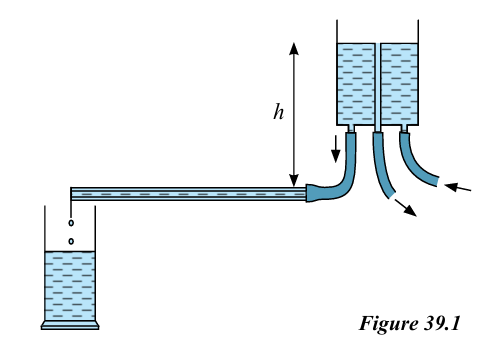 If is the volume of a liquid flowing in a time under a pressure through a capillary tube of length and radius , then according to Poiseuille's formula,
If the height between the liquid levels is , the density of the liquid is , and the acceleration due to gravity is ,
Hence,
Experimental Method
Wash the capillary tube first with sodium hydroxide solution, then with diluted hydrochloric acid, and finally with pure water. Connect the capillary tube to the constant-pressure apparatus using a rubber tube and fix it to the stand while leveling it with a spirit level.
Attach a piece of cotton thread near the open end of the tube, open the tap, and adjust the pressure so that the cotton thread vibrates slowly, indicating a constant pressure. Place a measuring cylinder under the open end of the tube and simultaneously start a stopwatch when the collected water reaches a specified level.
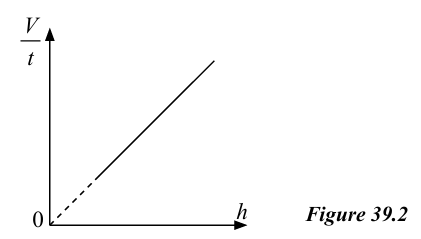
After a measured time interval (e.g., 1 minute), stop the watch and record the volume of water collected and the time taken. Measure the height of the liquid pressure head using a meter rule. Repeat the measurements for different values of by changing the pressure head and record the observations.
Measure the length of the capillary tube using a meter rule. Using a travelling microscope, measure the internal diameter of the tube in two mutually perpendicular directions.
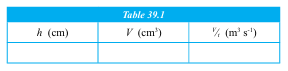
Let:
- = time of flow of water
- = total length of the capillary tube
- = diameter of the capillary tube in one direction
- = diameter of the capillary tube in the perpendicular direction
- = volume of water collected
- = liquid pressure head
Flow rate:
Mean diameter:
Radius of the capillary tube:
Using Poiseuille's equation,
the coefficient of viscosity is
Important Points
- A more accurate value for the internal radius of the capillary tube can be obtained by introducing a thread of mercury into the tube, measuring its length using the travelling microscope, measuring its mass using a triple beam balance, and calculating the radius using the appropriate formula.
- Since the term appears in Poiseuille’s equation, even a small error in measuring causes a large error in the final value of the coefficient of viscosity. Therefore, the radius must be measured with the highest possible accuracy.
- For high values of , the graph of against may become curved rather than linear. This indicates that the liquid velocity may have exceeded the critical velocity and the flow is no longer laminar. In such cases, only the straight-line portion of the graph should be used to determine the gradient.
- A cotton thread is hung at the outlet of the capillary tube to prevent water from flowing irregularly and to avoid the formation of water droplets caused by surface tension, which would create an additional pressure difference.