#19Q3) Waves and Optics
Adjustment of a spectometer and using it for determination of the refracting angle of a prism
Required Apparatus
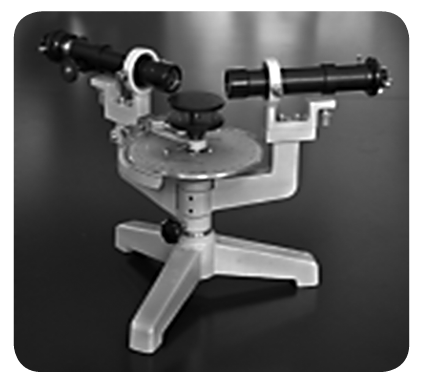
A spectrometer, an equilateral prism, a source of light such as an electric bulb or a lamp flame.
Scientific Theory
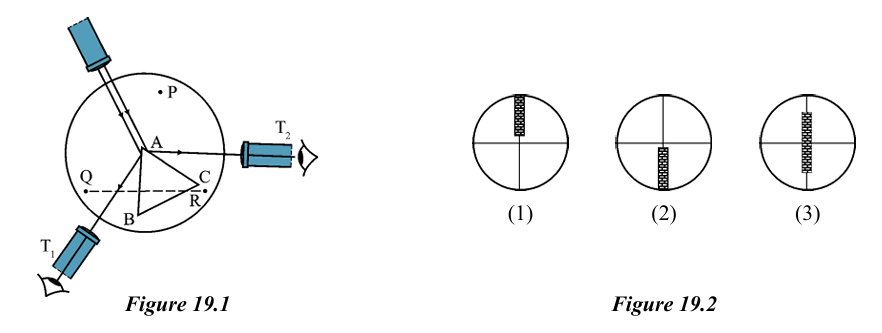
As shown in figure 19.1 if the angle between the light rays reflected from the prism face is , the difference between the readings corresponding to the positions and of the telescope is also .
The refracting (or prism) angle
Experimental Method
Adjustment of the telescope:
- First adjust the gap between the eye piece and the cross-wires until the cross wires are clearly seen.
- Next point the telescope to a distant object and adjust it until a clear image of the object is focussed on the cross wires.
Adjustment of the collimator:
- Adjust the slit of the collimator to be narrow and vertical and illuminate it by a source of light.
- Turn the telescope to be in line with the collimator, observe the image of the slit through the telescope and adjust the collimator until a sharp image of the slit is focussed on the cross wires.
Levelling the prism table:
- As shown in Figure 19.1 place the prism on the table so that the vertex of the prism is close to the centre of the table and a face (eg AB) is normal to the line joining any two levelling screws (eg Q and R).
- Now rotate the prism table with the prism until the light from the collimator falls on both faces of the prism adjacent to the vertex.
- Turn the telescope to the position to receive the light reflected from the face AB of the prism and observe the image of the slit through it. If it appears as seen in the fields of views (1) or (2) of figure 19.2, rotate one of the screws Q and R to make it appear symmetrical as shown in the field of view (3).
- Next turn the telescope to the position to receive the light reflected from the face AC. In this position too if the image appears as in a field of view (1) or (2), rotate the screw P only to make it appear symmetrical as in the field of view (3) in Figure 19.2.
- Repeat the above process until the image of the slit appears symmetrical in both positions and without any adjustment of screws. Note that only two levelling screws can be used for the adjustments.
Determination of the refracting angle of the prism:
- After levelling the prism table and with telescope in position note down the reading shown on the scale of the spectrometer.
- Next turn the telescope to the position and again note down the reading using the vernier scale.

Important Points
1
- Discuss any steps to be followed to obtain satisfactory results.
2
- More sensitive and accurate spectrometers are constructed with two vernier scales situated at the ends of a diameter of the circular main scale which is calibrated in half degrees. Readings should be taken from both vernier scales when taking readings.
3
- When obtaining the difference between the readings the difference between the positions of each vernier scale should be taken. The mean of the two values of A obtained from the two scales should be considered as the final result. This method of obtaining readings corrects any construction errors of the instrument such as the centre of the prism table not coinciding with the centre of the vernier scale.
4
- If in any case the zero of the main scale falls between the positions and of the telescope, the difference between the readings should be subtracted from and then divided by 2 to obtain the prism angle.