Determination of the specific heat capacity of a liquid by the method of cooling
Required Apparatus
A calorimeter having a polished outer surface and containing a lid and a stirrer, a thermometer, an electric fan, a stop clock, a triple beam balance, sufficient water, and the liquid.
Scientific Theory
Considering two warm bodies cooling in a continuous stream of air, if the nature and areas of their surfaces and the excess temperatures of the bodies over that of the surroundings are all identical, then their mean rates of loss of heat will be equal.
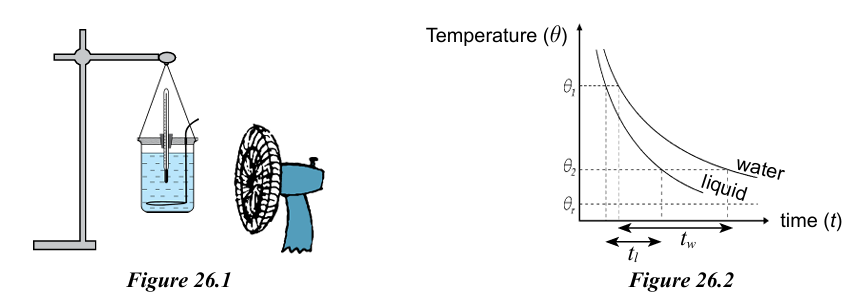
Consider an experiment in which using a single calorimeter, equal volumes of two warm liquids are allowed to cool under identical conditions. In this experiment let:
- : Mass of empty calorimeter with stirrer
- : Mass of calorimeter with water
- : Mass of calorimeter with an equal volume of liquid
- : Time taken by calorimeter with water to cool in the range
- : Time taken by calorimeter with liquid to cool in the range
- : Specific heat capacity of calorimeter metal
- : Specific heat capacity of water
- : Specific heat capacity of liquid
can be calculated by solving the above equation using standard values for and .
Experimental Method
- Measure the mass of the empty calorimeter with the stirrer.
- Fill up to about one centimetre from the top of the calorimeter with water heated to about , close with the lid and suspend from the stand as shown in the Figure 26.1.
- Allow the calorimeter to cool by the continuous blow of air from the electric fan placed near the calorimeter.
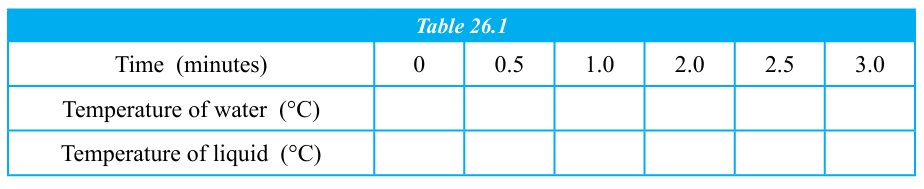
- While stirring the water continuously observe and note down its temperature at 30 s intervals till the temperature falls to about .
- Finally measure the mass of the calorimeter and note it down.
- Now remove the water from the calorimeter, wipe it well, fill it with an equal volume of heated liquid and repeat the experiment in the same manner.
- After recording the readings measure the mass of the calorimeter with the liquid.
- Draw smoothly the curves of temperature against time on the same coordinate axes for both water and liquid. From these temperature - time curves obtain the times taken by the liquid and water separatly to cool within the same temperature interval.
- Using standard values for and calculate the specific heat capacity () of the liquid as explained in the theory.
Important Points
- Conclude the value obtained in the calculation as the specific heat capacity of the liquid.
- Compare the value obtained in the experiment with the standard value of the specific heat capacity of the liquid. Forward your ideas and suggestions to minimize the experiment errors.
- This experiment can also be used for low excess temperatures such as those in the range - and no continuous flow of air is required here. However an environment of still air has to be maintined around the calorimeter.
- In the calculation it is more accurate to find the rate of fall of temperature relevant to a specific excess temperature as shown in Figure 26.3 than finding the mean rate of fall of temperature over a temperature range.
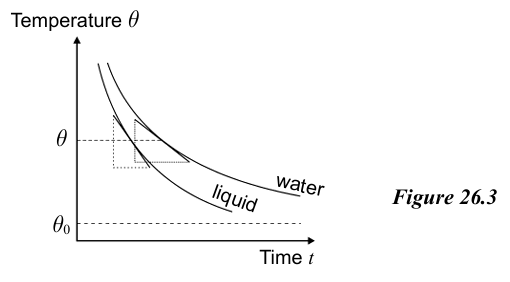
- As shown above, at temperature a horizontal line is drawn. At the points of intersection of the line with the curves tangents to the curves should be constructed using a plane mirror. If the gradients of the tangents are and :
(\frac{d\theta}{dt}){l}=\tan\alpha{l} \quad \text{and} \quad (\frac{d\theta}{dt}){w}=\tan\alpha{w}
(\frac{dQ}{dt}){w}=m_{1}c+(m_{2}-m_{1})c_{w}{w}
(\frac{dQ}{dt}){l}=m_{1}c+(m_{3}-m_{1})c_{l}{l}
(\frac{dQ}{dt}){w}=(\frac{dQ}{dt}){l}
\therefore m_{1}c+(m_{2}-m_{1})c_{w}{w}=m_{1}c+(m_{3}-m_{1})c_{l}{l}
The value of can be calculated from the above equation.