#17Q3) Waves and Optics
Determination of the angle of minimum deviation of a prism by observing the variation of deviation in a ray caused by the prism
Required Apparatus
An equilateral glass prism, a drawing board, drawing pins, a white sheet of paper, four optical pins, a ruler, and a protractor.
Scientific Theory
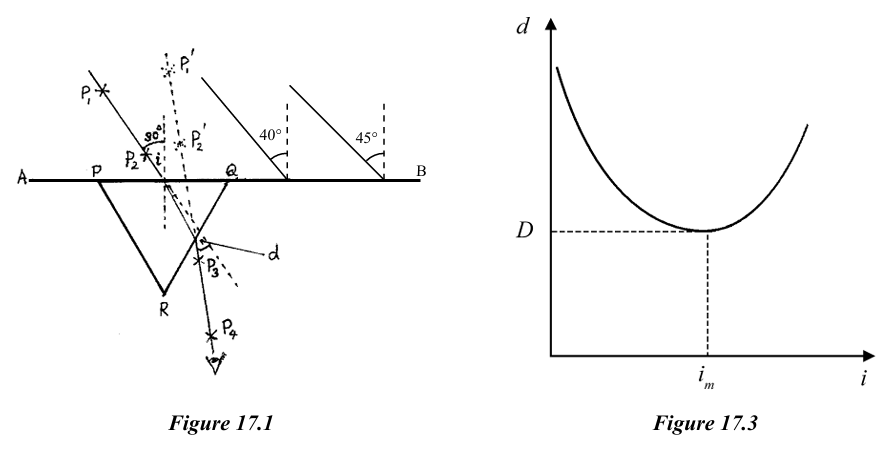
When the angle of incidence is gradually increased from a small value the angle of deviation first decreases, reaches a minimum and then increases. The angle of deviation corresponding to the minimum state is the angle of minimum deviation ().
Experimental Method
- Fix the white sheet of paper on the drawing board by drawing pins.
- Draw a straight line AB close to the middle of the paper along the length of the paper.
- Mark seven points at suitable gaps on the straight line and at each point draw normals to the line AB.
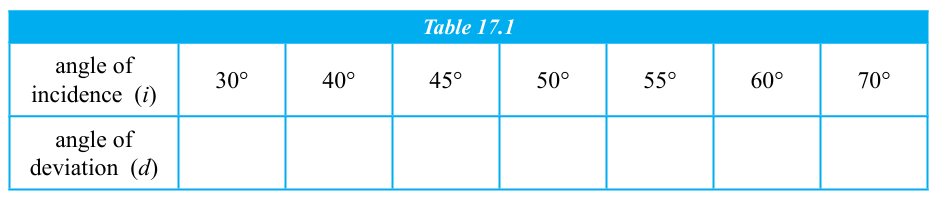
- Next draw lines inclined at angles of , , , , , , respectively to each normal.
- Place the given prism with one edge (PQ) on the line AB with the mid point of the edge coinciding with the point where the first normal is drawn on AB (Figure 17.1).
- Now fix two pins () vertically on the incident line at a considerable gap from each other.
- Observe the images of the two pins through the other face QR and fix two other pins () at a considerable gap to be in line with those images ().
- After marking the edges of the prism on the paper remove it from the paper.
- Obtain the emergent ray by the line joining the points where the pins and were fixed.
- By extending the incident ray forwards and the emergent ray backwards measure the angle of deviation () between the two lines.
- Repeat the experiment for other angles of incidence in the same way, measure the relevant angles of deviation and record the readings.
Important Points
1
- Determine the angle of deviation for a few more angles of incidence on either side of the angle of incidence (), relevant to minimum deviation. After obtaining angles of deviation for the range () and marking these values in the graph a more smooth curve can be obtained in and around . This would enable the determination of a more accurate value of the angle of minimum deviation.
2
- By fixing the pins far apart the direction of the emergent ray can be obtained more accurately.
3
- Discuss the actions to be taken to find the angle of deviation more accurately.